
Understanding awards
Equity awards can vary, but they share common features and follow a similar overall flow.
The equity award lifecycle
Your award moves through a few common stages. Knowing where your award is in the lifecycle can help you understand when action is needed—and when it isn’t.
1
Award date
Your award is granted. You can accept it (if required by your company) and view details on Benefits OnLine.
2
Vesting period
You may need to wait through a vesting or performance period before you can take action on your award or it's delivered/paid.
3
Delivery
A period after your award vests or is exercised; shares or cash are delivered.
4
What you can do next
Decide what to do next— hold or sell shares, reinvest dividends (if applicable), or transfer cash.
Vesting means your award becomes yours. Lapsing generally refers to restrictions or a vesting period ending, which usually coincides with vesting. Lapsing is not the same as losing an award. Expiration applies mainly to Stock Options and Stock Appreciation Rights if they aren’t exercised by a certain date.
TIP
Vesting schedules are set by your employer. You can view your award’s schedule in your grant agreement.
Payouts from vested or exercised awards are yours to keep when you leave your employer. Any cash in your brokerage account is also yours.
Depending on the grant agreement, vested stock options and stock appreciation rights may become unexercisable (and therefore expire/forfeit) at the time of termination or within a certain period of time post-termination. See your grant agreement for details.
If you leave before an award vests, you typically lose any unvested portion. However, there may be exceptions—for example, if you retire and certain requirements are met. See your grant agreement for details.
Choose an award type to learn more
Note: Not all award types may be available in your plan.
Restricted Stock Unit (RSU) awards are an unsecured promise from your company to deliver shares of company stock at a future date. Before you receive your shares, you have to wait a specified period of time (the "vesting period"). Once that time has passed, you’ll get shares of stock or cash that you can hold, sell or transfer.
When you receive RSUs:
- You don’t receive shares right away.
- The award is subject to a vesting period.
- Once vested, shares are delivered and taxes are paid.
- You can then choose to hold or sell your shares.
After you receive RSUs, you don’t receive shares right away. Instead, the award is subject to a vesting period set by your company.
Once the vesting period ends, your RSUs vest, and shares are delivered to you (or you receive cash, depending on your award).
Your vesting schedule is outlined in your grant agreement.
Example of a vesting schedule

Vesting schedules may be different. Your plan determines how vesting and withholding are handledand the number of shares you receive.
Generally, your award is taxed as ordinary income under federal U.S. tax law. Taxes are based on your award’s fair market value on its vesting date.
Depending on your plan, taxes may be covered through:
- Share withholding—Some shares are withheld to pay taxes.
- Sell to cover—Some shares are sold to pay taxes.
- Cash payment—You pay taxes separately with cash and keep all shares.
If you sell your shares at a later date, any additional gain or loss is generally subject to capital gains tax.
State and local taxes may also apply. Tax treatment can vary significantly outside the U.S., so consult local tax resources.
TIP
Taxes may apply when your award vests or is paid. If you later sell shares you received from the award, any increase or decrease in value after that date may also result in a gain or loss and may be subject to capital gains tax. Taxes can be complex—a tax advisor can help you understand your situation. Merrill and your company don’t provide tax advice.
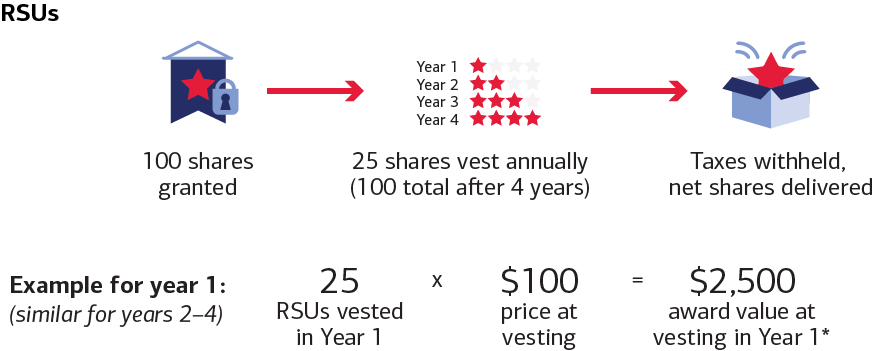
*This amount is treated as ordinary income, and taxes are withheld, depending on your plan features, before the remaining (net) shares are deposited into your brokerage account.
Restricted Stock Awards (also called Restricted Stock or Restricted Shares) are actual shares of your company’s stock granted to you, subject to a restriction period set by your company.
When you’re granted Restricted Stock:
- You receive actual shares, but they’re subject to a restriction period.
- During this time, certain conditions—often continued employment—must be met.
- Because they’re actual shares, you may have voting rights and receive dividends during the restriction period.
- When the restriction lapses, the shares become fully vested and transferable.
The vesting period (sometimes called the restriction period) is the time you must wait before the restrictions on your shares end.
- Vesting is usually time-based, but other conditions may apply.
- When vesting occurs, restrictions lapse, shares become transferable, and are delivered to your brokerage account.
- If the vesting conditions aren’t met, the shares are typically forfeited.
Your specific vesting schedule is outlined in your grant agreement.
Restricted Stock is generally taxed when the restrictions lapse (at vesting). The fair market value of the shares at vesting is typically treated as ordinary income, and any required taxes are usually due at that time.
Depending on your plan, taxes may be covered through:
- Share withholding—Some shares are withheld to pay taxes.
- Sell to cover—Some shares are sold to pay taxes.
- Cash payment—You pay taxes separately with cash and keep all shares.
If you sell your shares at a later date, any additional gain or loss is generally subject to capital gains tax.
State and local taxes may also apply. Tax treatment can vary significantly outside the U.S., so consult local tax resources.
TIP
Taxes can be complex—a tax advisor can help you understand your situation. Merrill and your company don’t provide tax advice.
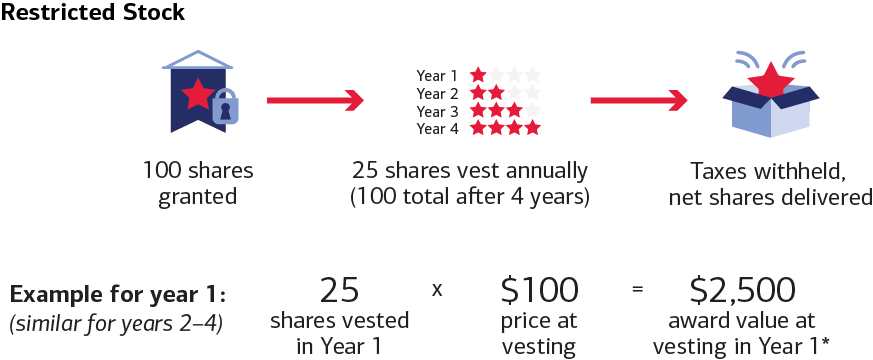
*This amount is treated as ordinary income, and taxes are withheld, depending on your plan features, before the remaining (net) shares are deposited into your brokerage account.
Restricted Cash Units are a cash-based award that pay out after a vesting period set by your company.
When you’re granted Restricted Cash Units:
- You don’t receive cash right away.
- The award is subject to a vesting period (usually based on continued employment).
- Once vested, a cash payment is made.
- You don’t need to “exercise” the award to receive payment.
The vesting period is the time you must wait before you receive the cash payment.
- Vesting is usually time‑based and set by your company.
- Once the vesting period ends and all requirements are met, the cash payment is made automatically.
- If the vesting conditions aren’t met, the award is typically forfeited.
Your vesting schedule is outlined in your grant agreement.
Restricted Cash Units are generally taxed when they vest and are paid. The cash payment is typically treated as ordinary income. Required taxes are generally withheld before the cash is paid to you.
State and local taxes may also apply. Tax treatment can vary significantly outside the U.S., so consult local tax resources.
TIP
Taxes can be complex—a tax advisor can help you understand your situation. Merrill and your company don’t provide tax advice.
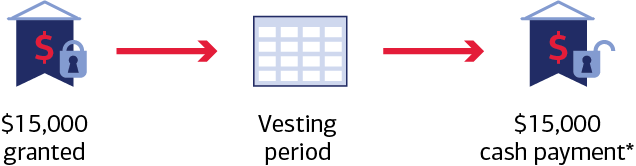
*This amount is treated as ordinary income, and taxes are withheld before cash is paid out.
Performance Units are an award that may pay out if your company meets certain performance goals. Depending on the terms of your award, payouts may be made in shares of company stock or cash. If performance goals are fully met, you may receive the full payout. If goals are partially met—or not met at all—you may receive a reduced payout or no payout.
When you receive Performance Units:
- You don’t receive shares or cash right away.
- The award is subject to a performance period set by your company.
- At the end of the performance period, payouts depend on whether performance goals are met.
- If goals are met, you receive shares, cash, or both, and taxes are paid.
- You can then choose to hold or sell shares, or transfer cash.
The performance period is the time during which the performance standards for the award are measured. At the end of this period, to the extent the performance standards are met, the award is vested and you’ll receive shares or cash (if your award pays out in cash).
Your grant agreement describes how performance is measured and how vesting is determined.
Generally, your award is taxed as ordinary income under federal U.S. tax law. Taxes are based on what your award is worth (its "fair market value") on its vesting date. Taxes are typically withheld on this date.
Depending on your plan, taxes may be covered through:
- Share withholding—Some shares are withheld to pay taxes.
- Sell to cover—Some shares are sold to pay taxes.
- Cash payment—You pay taxes separately with cash and keep all shares.
If you sell your shares later, any gain or loss in the share price is generally taxed as a capital gain or loss.
State and local taxes may also apply. Tax treatment can vary significantly outside the U.S., so consult local tax resources.
TIP
Taxes can be complex—a tax advisor can help you understand your situation. Merrill and your company don’t provide tax advice.
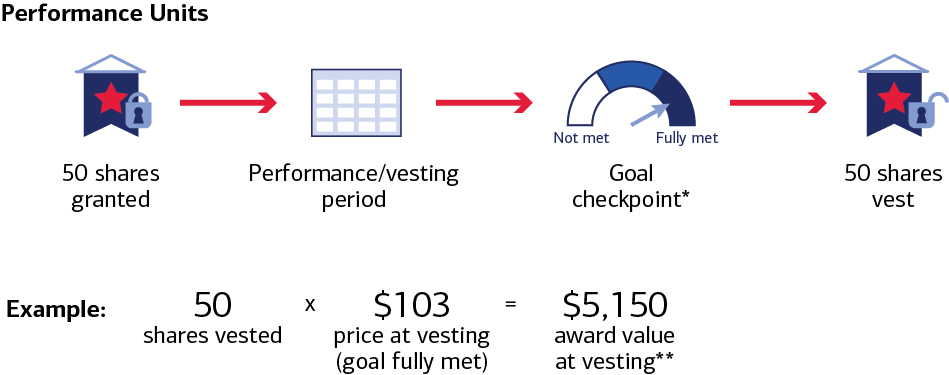
*Amount of shares vested is based on performance. If goal not met or only partially met, youmay receive fewer shares.
**This amount is treated as ordinary income, and taxes are withheld, depending on your plan features, before the remaining (net) shares are deposited into your brokerage account.
Performance Shares are actual shares of your company’s stock that you may receive if certain performance goals and vesting requirements are met.
When you’re granted Performance Shares:
- The shares are subject to company‑defined performance goals (such as revenue growth, etc.) and a waiting period.
- During this time, the shares generally can’t be sold or transferred.
- Because they’re actual shares, Performance Shares typically carry voting rights—meaning you can vote on certain company decisions—and may pay dividends (payments made to shareholders), even before they vest.
If the performance goals or other vesting conditions aren’t met, you may receive fewer shares—or none at all.
Performance Shares usually vest at the end of a performance period, which is the timeframe during which company goals are measured.
- Vesting depends on both performance results and any additional requirements outlined in your grant agreement.
- When the performance period ends and goals are met, your award vests.
- The vested shares are transferable and are delivered to your brokerage account according to your company’s schedule.
Your grant agreement describes how performance is measured and how vesting is determined.
Performance Shares are generally taxed when they vest. The fair market value of the vested shares is typically taxed as ordinary income. Any required taxes are generally due at vesting.
Depending on your plan, taxes may be covered through:
- Share withholding—Some shares are withheld to pay taxes.
- Sell to cover—Some shares are sold to pay taxes.
- Cash payment—You pay taxes separately with cash and keep all shares.
If you sell your shares later, any gain or loss in the share price is generally taxed as a capital gain or loss.
State and local taxes may also apply. Tax treatment can vary significantly outside the U.S., so consult local tax resources.
TIP
Taxes can be complex—a tax advisor can help you understand your situation. Merrill and your company don’t provide tax advice.
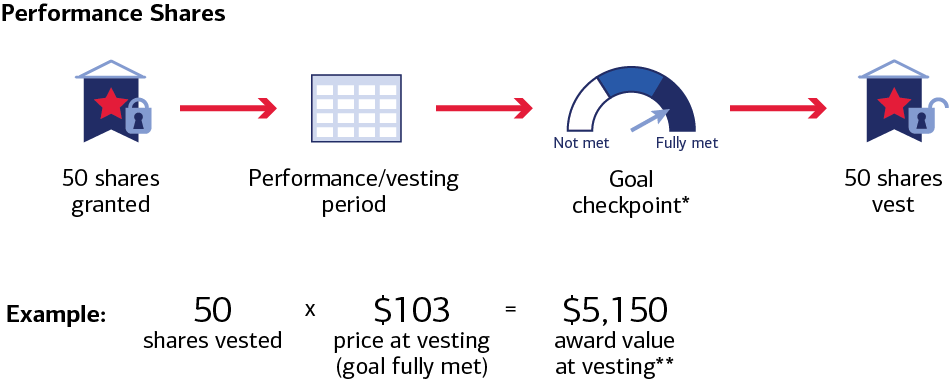
*Amount of shares vested is based on performance. If goal not met or only partially met, you may receive fewer shares.
**This amount is treated as ordinary income, and taxes are withheld, depending on your plan features, before the remaining (net) shares are deposited into your brokerage account.
Performance Cash Units are a cash‑based award that may be paid out if company performance goals and certain vesting requirements are met.
When you receive Performance Cash Units:
- You don’t receive cash right away.
- The payout is tied to company‑defined performance goals over a set performance period.
The final payout amount may be full, partial, or zero, depending on performance results.
Performance Cash Units typically vest at the end of a performance period.
- Performance is measured over the period defined in your grant agreement.
- Vesting depends on both performance outcomes and any additional requirements, such as continued employment.
- When the performance period ends and goals are met, the award vests and is paid.
Your grant agreement describes how performance is measured and how vesting is determined.
Performance Cash Units are generally taxed when the cash is paid. The payout is typically treated as ordinary income. Required taxes are usually withheld before you receive your payment.
State and local taxes may also apply. Tax treatment can vary significantly outside the U.S., so consult local tax resources.
TIP
Taxes can be complex—a tax advisor can help you understand your situation. Merrill and your company don’t provide tax advice.
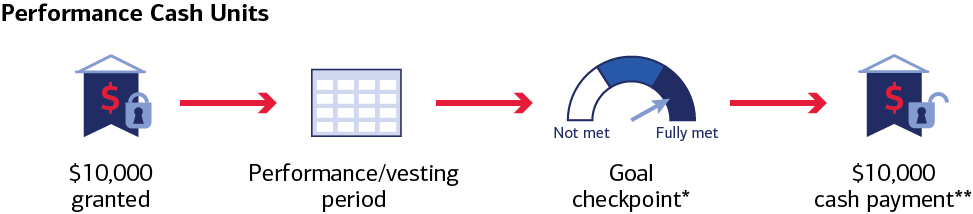
*Amount of cash vested is based on performance. If goal not met or only partially met, you may receive less cash.
**This amount is treated as ordinary income. Taxes are withheld before cash is paid out.
DEUs are commonly granted in connection with Restricted Stock Units (RSUs) or Performance Units.
Dividend Equivalent Units (DEUs) are tied to dividends your company pays on its stock. They’re designed to mirror the dividends you would have received if you owned the underlying shares.
When you receive DEUs:
- You don’t receive cash or stock right away.
- The value of the DEUs is generally based on the dividends paid on the underlying shares.
- DEUs typically accumulate during the vesting period of the associated award.
If the related award doesn’t vest, the DEUs are generally forfeited.
DEUs typically vest at the same time as the associated award. When the associated award vests, any accumulated DEUs are paid out. Payouts may be delivered in shares, cash, or a combination, depending on your plan.
Your vesting schedule is outlined in your grant agreement.
DEUs are generally taxed when they’re paid out, and the value of the payout is typically taxed as ordinary income. Required taxes are usually withheld at payout.
Depending on your plan, taxes are covered through the same method as the underlying award, which may include:
- Share withholding—Some shares are withheld for taxes.
- Sell to cover—Some shares are sold to pay taxes.
- Cash payment—You pay taxes separately with cash and keep all shares.
State and local taxes may also apply. Tax treatment can vary significantly outside the U.S., so consult local tax resources.
TIP
Taxes can be complex—a tax advisor can help you understand your situation. Merrill and your company don’t provide tax advice.
Nonqualified Stock Options (NSOs) give you the right to buy shares of your company’s stock at a set price (called the grant or exercise price) for a specific period of time. There’s typically a waiting period (also called the “vesting period”) before you can exercise your options. Once your options vest, you can choose if and when to exercise them during the exercise period before they expire. If the stock price is higher than the exercise price, your options may have value.
When you receive NSOs:
- You don’t receive shares right away.
- The options are subject to a vesting period.
- Once vested, you decide if and when to exercise your options.
- When you exercise, you receive shares or cash (depending on your plan).
- You can then choose to hold or sell shares, or transfer cash.
If you don’t exercise your NSOs before they expire, your options are forfeited.
The vesting period is the time you must wait before you can exercise your NSOs.
- Vesting is usually time‑based and set by your company.
- Once your NSOs vest, you can exercise them during the exercise period, which ends on the expiration date, or earlier if your employment ends (depending on your plan).
Your grant agreement outlines your vesting schedule and deadlines.
When you exercise your NSOs, you’ll need to choose how to pay your exercise costs and any required taxes—and whether to receive cash, shares or both.
Available exercise methods may include:
- Cashless sell—All shares are sold. Proceeds cover costs and taxes, and you receive the remaining amount in cash.
- Cashless hold—Some shares are sold to cover costs and taxes. The remaining shares are deposited into your brokerage account.
- Cash purchase—You pay costs and taxes with funds you provide to Merrill. All shares are deposited into your brokerage account.
- Stock swap—You use existing shares to pay the costs. You receive the net number of new shares.
- Cash partial exercise—You pay the costs in cash, and some shares are sold to cover taxes. The remaining shares are deposited into your brokerage account.
Available methods depend on your plan. See your grant agreement for details.
NSOs are generally taxed as ordinary income when you exercise them. The taxable amount is the difference between the exercise price and the stock’s fair market value at the time of exercise.
When you later sell shares, any additional gain is generally taxed as a capital gain, depending on how long you’ve held the shares.
State and local taxes may also apply. Tax treatment can vary significantly outside the U.S., so consult local tax resources.
TIP
Taxes can be complex—a tax advisor can help you understand your situation. Merrill and your company don’t provide tax advice.
Incentive Stock Options (ISOs) give you the right to buy shares of your company’s stock at a set price (called the grant or exercise price) for a specific period of time. ISOs may qualify for special tax treatment if certain requirements are met.
When you receive an ISO grant:
- You don’t receive shares right away.
- You’re given the option to buy a set number of shares at the grant price.
- The options are subject to a vesting period, and you can’t exercise them until they vest.
- When you exercise, you receive shares or cash (depending on your plan).
- You can then choose to hold or sell shares.
If you don’t exercise your ISOs before they expire, your options are forfeited.
The vesting period is the time you must wait before you can exercise your ISOs and purchase shares.
- Vesting is usually time‑based and set by your company.
- Once your ISOs vest, you can exercise them during the exercise period, which ends on the expiration date, or earlier if your employment ends (depending on your plan). If the stock price is higher than the exercise price, your options may have value.
Your grant agreement outlines your vesting schedule and deadlines.
When you exercise your ISOs, you’ll need to choose how to pay your exercise costs and any required taxes—and whether to receive cash, shares or both.
Available exercise methods may include:
- Cashless sell—All shares are sold. Proceeds cover costs and taxes, and you receive the remaining amount in cash.
- Cashless hold—Some shares are sold to cover costs and taxes. The remaining shares are deposited into your brokerage account.
- Cash purchase—You pay costs and taxes with funds you provide to Merrill. All shares are deposited into your brokerage account.
- Stock swap—You use existing shares to pay the costs. You receive the net number of new shares.
- Cash partial exercise—You pay the costs in cash, and some shares are sold to cover taxes. The remaining shares are deposited into your brokerage account.
Available methods depend on your plan. See your grant agreement for details.
Generally, no federal income tax is due when you exercise ISOs. However, the difference between the grant price and the stock’s fair market value at exercise may be considered for Alternative Minimum Tax (AMT) purposes.
When you sell your shares, taxes depend on how long you’ve held them. If you hold the shares more than one year after exercise and two years after the grant date, the difference between the exercise price and the fair market value on the date of sale is generally taxed at long‑term capital gains rates (rather than as ordinary income). If these holding requirements aren’t met, the sale may be taxed differently.
State and local taxes may also apply. Tax treatment can vary significantly outside the U.S., so consult local tax resources.
TIP
Taxes can be complex—a tax advisor can help you understand your situation. Merrill and your company don’t provide tax advice.
Stock Appreciation Rights (SARs) give you the right to receive the increase in value of your company’s stock over a set period of time. Unlike stock options, you don’t buy shares—you receive the value of the stock’s increase, usually in shares, cash, or both.
When you’re granted SARs:
- You don’t receive stock or cash right away.
- The award gives you the potential to benefit from increases in your company’s stock price above a set base price.
- SARs are subject to a vesting period, and you can’t exercise them until they vest.
If you don’t exercise your SARs before their expiration date, they generally expire and have no value.
The vesting period is the time you must wait before you can exercise your SARs.
- Vesting is typically based on continued employment over a set period.
- Once your SARs vest, you can exercise them during the exercise period, which ends on the expiration date, or earlier if your employment ends (depending on your plan).
Your vesting schedule and deadlines are detailed in your grant agreement.
SARs are generally taxed when you exercise them. The value you receive at exercise—the difference between the stock’s fair market value and the base price—is generally taxed as ordinary income.
Taxes are generally withheld from the value you receive when you exercise your SARs. Depending on your plan, you may receive the remaining value in shares, cash, or both.
If you receive shares and later sell them, any additional gain or loss after exercise is generally subject to capital gains taxes.
State and local taxes may also apply. Tax treatment can vary significantly outside the U.S., so consult local tax resources.
TIP
Taxes can be complex—a tax advisor can help you understand your situation. Merrill and your company don’t provide tax advice.
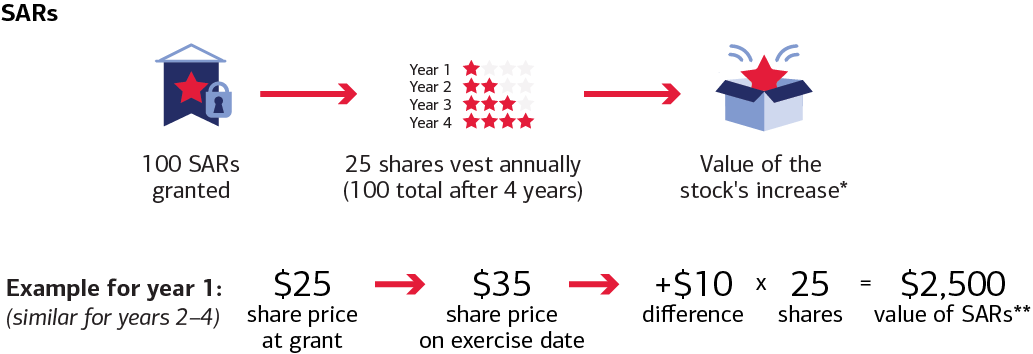
*Your award’s value is the difference between the grant price and the price on the exercise date multipliedby the number of shares.
**You receive the value — typically in shares, cash or both — minus any required taxes. If you receive shares, you can hold, sell or transfer them.
Exercising a stock option means using your option to purchase company stock at the exercise price during the exercise period.
The exercise period is the time during which you can use your vested stock options to purchase shares before the options expire.
Expiration is the date your stock options end. If you don't exercise your vested stock options before the expiration date, they expire and can no longer be used to purchase shares.
You may have heard the phrase “in the money.” This means the stock price is higher than the exercise price.
A capital gain is the increase in value of an investment over time. If you sell shares for more than they were worth when you received them, the gain may be subject to capital gains tax.

Any transactions in connection with your plan in your Merrill brokerage account are subject to the terms and conditions of that account. This material does not constitute an offer or invitation to buy any securities. Any offer to buy securities from your company would be made only by a prospectus in accordance with the Securities Act of 1933 as amended, and all applicable laws.